Farmers for Forest Protection Foundation (4F)
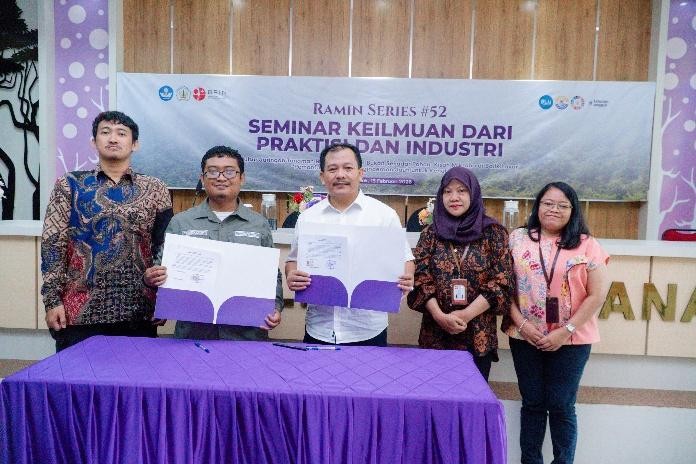
In the process of expanding the reach of its work in the field of environmental conservation and community capacity building, on 13 February 2026, 4F formalised a cooperative agreement with the Faculty of Forestry, Tanjungpura University (Fahutan UNTAN). This collaboration was formalised through the signing of a Cooperation Agreement Letter (SPK/MoU) at the Scientific Seminar from Practitioners and Industry (RAMIN) Series 52, hosted by the Faculty of Forestry, Tanjungpura University. The speakers at this seminar were three researchers from BRIN (the National Research and Innovation Agency), who had previously collaborated with 4F on research concerning the ‘Influence of Forest Conservation and Management on Land Productivity and Plant Disease Control’. This research was conducted to understand the relationship between the condition of forest ecosystems and the sustainability of agricultural systems surrounding forested areas. In other words, this seminar concretely served as a symbol of the cooperation and partnership among three key actors in supporting the protection and sustainable management of forests, namely academics (Fahutan UNTAN), researchers (BRIN), and practitioners (4F).
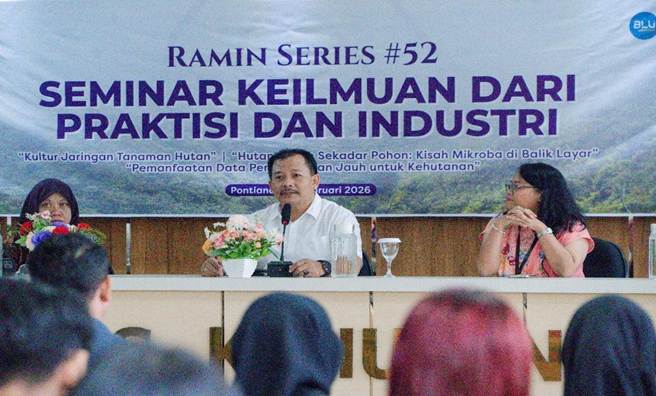
Figure 1. Dr. Ir. M. Sofwan Anwari, S.Si., M.Si., Vice Dean for Academic Affairs of Fahutan UNTAN (centre), accompanied by Dr. Ir. Asri Insiana Putri, BRIN Researcher (left), and Margareta Christita, S. Hut., M. Biotech., Ph.D, BRIN Researcher (right).
Documentation: Fahutan UNTAN, BRIN, and 4F
Academic Transformation for Tangible Impact
At this RAMIN Series #52, through Dr. Ir. M. Sofwan Anwari, S.Si., M.Si. (Vice Dean), Fahutan UNTAN articulated its strategy for breaking down the barriers between campus theory and field requirements through the ‘Impactful Campus’ programme. This strategic step represents the faculty’s vision in transforming forestry education into an ecosystem that directly benefits communities on the ground level.
Fahutan UNTAN has three main pillars in implementing the ‘Impactful Campus’ programme: curriculum relevance, by integrating practitioner perspectives into the classroom to bridge competency gaps; industry collaboration, by making external networks the living laboratory and primary locus of student research; and accelerated graduation, by synergising internship and research programmes so that students can complete their theses earlier using quality data from partners.
In pursuing the ambitious target of accelerated graduation—where 45% of students are targeted to graduate on time before the eighth semester—the faculty has revolutionised the Independent Learning–Independent Campus (MBKM) curriculum into a more structured scheme. In the fifth semester, students undertake an ‘Impactful Internship’ as an industry familiarisation phase, which is then refined in the seventh semester through ‘Impactful Research’—a final project scheme directly integrated with research projects from partners such as BRIN and 4F. However, this strategy is not merely about the pursuit of academic qualifications and graduation targets; it also serves as a form of the campus’s tangible contribution to the needs of the wider community. “This RAMIN activity has been running for more than four years as the academic heartbeat outside the classroom. Today, through the Cooperation Agreement with 4F and BRIN, we ensure that students are not merely pursuing a degree, but have a sharp relevance to industry needs and the sustainability of the forests,” said Dr. Ir. M. Sofwan Anwari, S.Si., M.Si., Vice Dean for Academic Affairs of Fahutan UNTAN, moments before the signing of the Cooperation Agreement.
Figure 2. Group photo following the signing of the Cooperation Agreement. From left to right: Galdita Aruba Chulafak, S.T., MSE (BRIN Researcher), Harits Yowansyah (Programme Manager, 4F), Dr. Ir. M. Sofwan Anwari, S.Si., M.Si. (Vice Dean for Academic Affairs, Fahutan UNTAN), Dr. Ir. Asri Insiana Putri (BRIN Researcher), and Margareta Christita, S. Hut., M. Biotech., Ph.D (BRIN Researcher).
Documentation: Fahutan UNTAN, BRIN, and 4F
Inviting Student Involvement in Sustaining the Relationship Between People and the Forest
Following the remarks from the representative of the Dean of Fahutan UNTAN, the Executive Director of 4F, Tirza Pandelaki, who attended remotely, provided an explanation of 4F and the relationship between people and the future of forests. Tirza observed that, based on the lived experiences of communities in 4F’s areas of work, people regard the forest as both a ‘supermarket’ and an ‘identity’. “The forest is called a supermarket because it is where they obtain medicine, timber for household needs, water sources, and a variety of non-timber forest products. This means the forest sustains everyday life. Equally, they call the forest their identity. As it turns out, in West Kalimantan, particularly in several locations we have visited, the forest holds history, the traces of ancestors, cultural values, and local wisdom. So, within indigenous communities, we find that the forest serves as a concrete bridge between cultural heritage and life today. Thus, yes, the forest is not merely what we might call part of the landscape, but a living space that connects generations,” said Tirza.
That is why, in the work of 4F, the focus is not solely on the forest as tree cover sheltering a particular area, but also on evidence of maintaining the relationship between people and nature. “We are not only talking about protecting forest cover; we are talking about preserving the relationship between people and the forest. That is why we work for farmers, forest, food, and future—for farmers and communities who depend on the landscape, for the forest that sustains life, for food that forms the basis of sustainability, and for the future of generations to come,” Tirza affirmed.
Tirza also expressed concern that if this relationship between people and the forest is not maintained, the forest will be lost and the identity of the communities around it will be damaged. This is where the role of students as the next generation—equipped with the knowledge and capacity to care for nature—becomes vital. “In these villages, we see that when young people are no longer connected to the forest, its sustainability becomes fragile. But when young people are involved—for example, in participatory mapping, in forest monitoring systems, in discussions on village spatial planning—they begin to see the forest not as part of the past, but as part of the future as well. This is where I see the relevance of the university and 4F becoming strong, with connections for the work ahead, where the university is not merely a place to produce theory, but also a space for building critical awareness, innovation, and a commitment to sustainability, as well as a space for the formation of values,” Tirza explained.
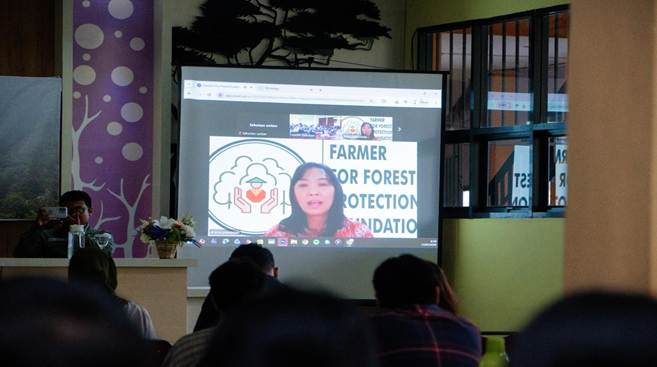
Figure 3. Director of 4F, Tirza Pandelaki, delivering remarks remotely.
Source: 4F Documentation.
The Scientific Pillar: BRIN’s Contribution to the Digitalisation of Forest Management
The BRIN research team, led by Dr. Asri Insiana Putri, in collaboration with 4F, has been conducting research on the relationship between conservation and agricultural land productivity. The findings revealed that lands located in proximity to conservation areas or forested areas exhibit good productivity, whereas oil palm lands situated far from conservation areas experience a decline in productivity. In other words, community-led forest conservation efforts have a linear influence on the productivity of their oil palm land.
At RAMIN Series #52, Dr. Asri Insiana Putri, Dr. Margareta Kristita (Tita), and Galdita Aruba Khulafak presented how cutting-edge technology can breathe new life into conservation efforts. Dr. Asri shared her insights on plant tissue culture for forest species, particularly regarding vegetative propagation techniques to produce superior seedlings genetically identical to their parent plants—a method crucial to the conservation of rare species such as Ramin (Gonystylus bancanus).
Dr. Tita delivered a lecture on microbiology in forest sustainability and restoration. She provided examples of the potential of local microbes—particularly Azotobacter isolates she discovered directly from habitats in Sanggau—as an affordable biofertiliser to accelerate the growth of forest plant seedlings. She also brought research at the cellular level that is crucial for post-mining land rehabilitation. She explained the use of the enzyme Chromate reductase to reduce the toxicity of the hazardous heavy metal hexavalent Chromium into a safe form. Meanwhile, Galdita Aruba presented on remote sensing technology, such as the use of satellite imagery and drone technology for carbon stock mapping, early detection of fires, and plant health analysis. She also explained the application of Deep Learning and Convolutional Neural Networks (CNN) to detect the number of oil palm trees and monitor illegal logging via satellite imagery in real time.
The collaborative research process between 4F and BRIN is ongoing. In addition to fieldwork, the BRIN research team is also conducting laboratory research on oil palm Ganoderma—a soil-borne pathogenic fungus (primarily Ganoderma boninense) that causes Basal Stem Rot (BSR) disease. This fungus is the greatest scourge of plantations as it attacks the roots and trunk, blocking nutrient intake, reducing yields, and causing oil palm trees to die or topple.
Hopes for Implementation at the Ground Level
The RAMIN Series #52 Seminar affirmed that the future of Borneo’s forests depends on a robust triple helix model: progressive faculty policy, the sharpness of BRIN’s research, and 4F’s social proximity to village communities. The signing of the Memorandum of Understanding is not a finishing line, but rather the beginning of a unified movement to ensure that the forest remains a living identity—not merely a memory fading alongside the diminishing significance of the forest.
This collaboration is hoped not to remain at the level of documentation alone, but to promptly generate real action at the ground level involving academics and practitioners alike. “The hope going forward, through the collaboration we have already forged with BRIN, and now together with the university, is that we can collectively work to ensure that community-based forest protection practices are strengthened by scientific methodology, credible monitoring systems, and data-driven analysis. Furthermore, students are also very welcome to be involved—for instance, in participatory research, socio-ecological studies, and even in the development of adaptive forest management,” said Tirza in the closing remarks of her address.